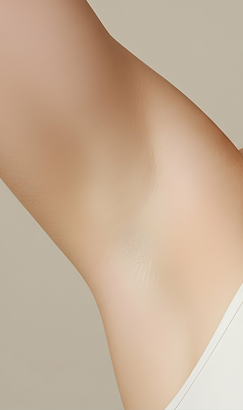
Five minutes a side. The smallest area we treat, and the one that changes fastest.
If you are laser-curious and not yet convinced, underarms are where we tell you to start, and we say that against our own commercial interest because it is a small package. Two reasons. The first is that an underarm is roughly the size of your palm, so the treatment is genuinely over in a few minutes per side — you can do both on a lunch break and go back to work. The second is that the hair growing there is close to the perfect target, which means you tend to see the change earlier here than anywhere else, and seeing it is what turns a skeptic into someone who finishes the series.
Underarm hair is dense, coarse, terminal hair packed with melanin, sitting on skin that has never seen the sun in its life. Melanin in the hair is the target; pigment in the skin is the thing you want out of the way. A dark coarse hair against pale, sun-shielded skin is about the widest gap between those two you will find on a body, and that gap is the entire mechanism the GentleMax Pro operates on. It is why underarms are almost the textbook illustration of what this technology does well.
Most clients need 6 to 8 sessions spaced 4 to 6 weeks apart to complete an underarm series, and this area is often at the friendlier end of it. Many people notice they are shaving less by session three or four, well before the series is done. Results vary with hair colour, skin tone and hormones — but if your underarm hair is dark and coarse, you are in the group this treatment was designed around.
Underarm skin is thin and the hair in it is coarse, and those two facts together are what create sensation. Coarse hair absorbs more light, converts more of it to heat, and there is not much tissue between that heat and the nerves. So it does snap. Nobody will pretend otherwise.
But this is where the small size of the area does the heavy lifting. The entire underarm is a few dozen pulses. The GentleMax Pro fires a burst of cryogen onto the skin milliseconds before each one, chilling the surface while the energy goes below it, and the whole thing is finished roughly as fast as you can decide it is unpleasant. Clients routinely tell us it is less painful than a wax and considerably shorter. It also eases as the series progresses — by session four there is simply less hair to absorb energy, and the sensation drops with it. Lift your arm, hold still, done.

This is the complaint we hear most and the one almost nobody says out loud. You shave in the morning and by the afternoon there is a faint grey-blue cast under the skin — not stubble you can feel, exactly, but the shadow of dark shafts sitting just under a thin, pale surface. It is why a lot of people feel self-conscious in a sleeveless dress on a day they definitely shaved.
That shadow is hair, not pigment, so it is squarely within what a laser can address. Reduce the number of coarse dark shafts in the follicle and the thing casting the shadow goes with them. Many clients say this is the change they notice first, before they consciously register that they are shaving less often.
One honest distinction, though, because they get confused constantly: if the skin itself has darkened over years of shaving — actual discolouration in the skin rather than shafts beneath it — that is a pigment issue and hair removal will not touch it. That is a different treatment entirely, and our IPL photofacial page is the right place to look. Your provider can tell which one you have in about ten seconds of looking at it.
This one is specific to underarms and it matters. Antiperspirant is designed to sit in and around the follicle, and product residue on the skin surface where a laser is about to deliver energy is not something you want. Wash it off, or skip it that morning and put it back on the next day once the skin has calmed.
Shave the night before or that morning. Shaving is not just permitted between sessions, it is what we want — it trims the shaft and leaves the follicle and its pigment intact. Waxing, plucking, threading and epilating creams pull the target out entirely, so stop those a full four weeks before your first session.
Expect warmth and possibly small pink bumps around the follicles for a few hours. Skip the sauna, the hot tub and the hard workout for about two days. Sweat and friction in a fold on freshly treated skin is the one thing that reliably annoys it — the appointment is easy, the gym that afternoon is not.
And then the thing that convinces people the session failed: for a week or two afterwards, hairs appear to grow. They are not growing. Treated follicles push the damaged shaft out as they shed, and it looks identical to regrowth right up until it wipes away with a washcloth. Do not wax it, do not panic, keep shaving normally.
This comes up in nearly every underarm consultation and the answer disappoints roughly half the people who ask, so we would rather you read it here than hope for it in the chair. Laser hair reduction targets pigment in hair. It does not target sweat glands, and it is not a treatment for excessive sweating. If sweating is the actual problem you are trying to solve, that is a completely different conversation and a completely different treatment, and you should have it with a provider rather than hope a hair laser handles it as a side effect.
What clients do consistently report is that a shaved-smooth underarm holds less moisture against the skin and feels less swampy in July than a stubbly one does. That is a comfort observation, not a medical claim, and we are labelling it as one.
The other honest limit is pigment, and it is the same limit everywhere on the body. Blonde, red, grey and white hair carry little or none of the melanin these wavelengths absorb. No target, no heat, no result — and turning the energy up on hair that will not absorb it only endangers the skin. Underarm hair is dark and coarse for most people, which is why this area works so well, but if yours is not, we will tell you at the consultation and we will not sell you a package.
There is a specific misery to a humid Missouri summer that underarms bear the brunt of. Sleeveless is not a style choice from June through September here, it is a survival strategy — and that means the area you were quietly not thinking about in February is suddenly on display every day for four months, in a climate where you are sweating into it. The people who come in for underarms in May are usually the people who spent last August shaving daily and getting razor burn for their trouble.
The advantage underarms have over almost every other area is that they are essentially never sun-exposed. Sun is the great complicating factor in laser work — a fresh tan raises the pigment in your skin and narrows the gap between target and background that the treatment depends on. Your underarm skin does not tan. It stays the colour it was, all year, which is one of the reasons this area is so straightforward and one of the reasons you can start a series in June without the calendar fighting you. Legs do not get that luxury; see legs for why that timing conversation goes differently.
One thing worth planning around: give yourself room before a wedding, a reunion, or anything sleeveless and photographed. Not because anything dramatic happens — it does not — but a session leaves the skin pink and slightly bumpy for a few hours to a day, and there is no reason to find that out the morning of. A week of buffer solves it.
Laser Me has been in St. Louis since 2000: a mother-and-daughter practice, more than 10,000 clients, over 100,000 treatments performed. Underarms are the area we have treated more than any other, and it is not close. If you are weighing what to add, bikini is the pairing clients choose most, and the full list is on our treatment areas page.